The Fundamental Theorem of Homomorphisms
01/06/2026
The first important theorem a student of algebra learns is the fundamental theorem of homomorphisms (FTH), or more commonly a special case known as the first isomorphism theorem. However, the theorem has more depth than might seem at first look and one cannot avoid seeing it pop up in various places along the journey to mastering algebra. In this post we will explore the basics, then move to progressively deeper waters to see how far the theorem can get us. The reader with prior exposure to abstract algebra is encouraged to skim over the easy sections.
Let us first spell out the statement of the FTH. Suppose is a homomorphism of groups, vector spaces, modules, rings, etc. and a normal subgroup, vector subspace, submodule, ideal, etc. of . If is contained in the kernel of , then there is a unique homomorphism making the below triangle commute where is the usual projection to the quotient. By commutativity we mean , where denotes function composition. If , then is injective. In particular, we obtain an isomorphism The proof of this theorem is surprisingly easy and I encourage the reader to choose their favourite algebraic structure and give a try at proving it before reading on.
The FTH is a statement of universal algebra, which means it works for all algebraic structures. As a fun consequence, we can state the FTH for sets, since they are algebras in a trivial way. In this case the FTH says the following. Suppose is any function of sets. Given an equivalence relation on such that implies , there is a unique function making the below triangle commute. If identifies all the pairs such that , then is an injection.
One could wonder if the FTH generalises further from universal algebra to category theory. For those interested, I leave a link to this MSE post.
Basic applications
The FTH is most often used to prove isomorphisms of the type . The general approach is to construct a surjection and prove that its kernel coincides with . As a basic example, suppose we want to show that , where is the cyclic group of order . Recall that the elements of are of the form , where is a generator of . We simply define the obvious homomorphism Now, since generates , it follows directly that is surjective with kernel . Thus, the FTH implies . Applying the same argument to the determinant gives and applying it to the sign function gives , where is the symmetric group and is the alternating group.
The FTH isn't only good for proving isomorphisms in specific cases, but also for proving more general statements. For example, the second and third isomorphism theorems are proved using the FTH. The second isomorphism theorem states where and are subgroups of some larger group and is normal. The isomorphism is obtained from the FTH by showing that the homomorphism is surjective with kernel .
The third isomorphism theorem states where and are normal subgroups of such that . Again, this follows from the FTH after showing the homomorphism is surjective with kernel .
Exact sequences
As we saw above, the FTH gives us the isomorphism whenever is a surjection. In fact, we get something more. The FTH implies the existence of a commutative triangle where we denote for short. We could read this diagram as saying that is in some sense "isomorphic" to the projection , because the two maps differ only by an isomorphism on the targets. Thus, we could make the statement that
Every surjective homomorphism is a quotient homomorphism.
Indeed, algebraists often use the terms "surjection" and "quotient" interchangeably when talking about a homomorphism.
Let's assume for a moment that we are working with Abelian structures such as Abelian groups, vector spaces or modules. In this setting we can form the quotient of by any subobject , whereas one needs to require that the subobject be "normal" in general. Now, we can define a correspondence where an injection is mapped to the projection onto the quotient and a surjection is mapped to the inclusion of the kernel into . One half of the bijectivity of this correspondence comes directly from the FTH and the above philosophy that surjections are quotients. The reader should pause at this point and convince themselves that this correspondence is indeed bijective.
Hence, the FTH teaches us that injections and surjections of Abelian structures come in pairs. Now, take a such a pair of homomorphisms and put them after one another where is an injection and is the corresponding surjection. This means and . Observe that this "sequence" satisfies . This property is called exactness, and more precisely, one says that the sequence is exact at . Since is injective and is surjective, the sequences are exact at and respectively (can you see why?) Thus, we get an exact sequence meaning it is exact at , and . An exact sequence of this form is called a short exact sequence (SES). In other words, any given injection or surjection can be "completed" into a SES, so every injection-surjection pair gives rise to a SES. Conversely, every SES defines an injection-surjection pair.
Abstracting the FTH
Since exactness can express injectivity and surjectivity, it can also characterise isomorphisms. Furthermore, it can neatly express the duality between injections and surjections that arises from the FTH. We could now ask if the FTH itself could be stated using only the language of exact sequences, and indeed this is possible. The following is equivalent to the FTH. Any diagram with exact rows that commutes, i.e. , can be completed uniquely into a diagram that commutes, i.e. also. Furthermore, if is surjective, then is injective. As a remark, this latter statement is generalised by the famous snake lemma.
Exact sequences and commutative diagrams provide a language that can express the FTH, but it also leads to natural extensions of it. As a concrete example, note that the FTH implies the rank-nullity theorem for vector spaces: In terms of exact sequences, this is equivalent to saying that for any SES of vector spaces, the alternating sum of their dimensions vanishes It turns out that this way of expressing the theorem generalises directly. Indeed, for any exact sequence of vector spaces, the alternating sum of their dimensions vanishes The concise way to express this fact is by saying: "dimension is additive over exact sequences".
In conclusion, properties of homomorphisms (injectivity, surjectivity and bijectivity) can be stated in terms of exactness, and the FTH can be applied and in some senses extended using the language of exact sequences and commutative diagrams. Therefore, most of basic algebra can be handled in this diagrammatic framework, because the basic proofs often consist in checking some homomorphism is injective or surjective and applying the FTH in the right places. While not everything reduces to exactness and commutative diagrams, this higher level of abstraction allows for stating, discovering and applying more complicated results.
Visualising homomorphisms
For me the most satisfying insight provided by the FTH is a visual interpretation of homomorphisms. To see how this works, fix a homomorphism . At the present need not be surjective. But note that the morphism doesn't "see" the stuff outside of anyways, so we might as well assume is surjective.
In the previous section we learnt that every surjection "is" a quotient. Now, there is a way to visually think of quotient homomorphisms which I find useful, and thanks to the FTH we can use the same visual intuition for all homomorphisms. Here is how I would draw a quotient homomorphism schematically.
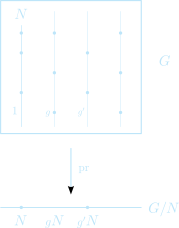
I visualise the act of taking a quotient as collapsing the cosets, which I imagine as being "parallel" to each other. If you have seen algebraic topology or differential geometry, you might note that this is vaguely analogous to how you would think of vector or fibre bundles.
Groups of order 8
Not only do we have this static visualisation, but we can now take a group action on the domain of (the total space), and try to see how it "moves the points around" in the picture. Consider the action of on itself by left-multiplication. If we fix and look at what happens when we multiply that with the elements (points) of some coset (fibre), then we see that it moves them to the coset . Why is this useful? At least to me this visual way of thinking was helpful in approaching the problem of classifying small groups. Let's take the groups of order 8 as an example.
In fact, I think that trying to classify small groups is among the best ways of forming a solid understanding of basic group theory, so I will not rob you of the opportunity to do it yourself. Instead, I strongly encourage the reader to try classifying some groups, and I will only provide a rough outline of the classification of groups of order 8. If you have had a go at classifying groups of order 8, you can take a look at the below hints.
- I would start by looking at the orders of the group elements.
- First I would consider the case where every non-trivial element has order 2. In this case the group generated by a fixed non-trivial element is normal and the quotient is the Klein 4-group. By staring at the first figure below for long enough should help in deciding which group must be.
- In the second case, there is an element of order 4. Since has index 2, it is normal, so one can look at the quotient map . Taking any gives . See the second figure below.
- Next, suppose no element of has order 2. If any element of has order 8, we know what is, so we may suppose all the elements of have order 4. Now, this means has precisely one element of order 2 and the rest of the non-trivial elements have order 4. Thus, all of their squares must be the element of order 2. Now, you can think of it this way: is a non-trivial solution to the equation . Maybe try writing . The remaining non-trivial elements are solutions to the equation .
- Now, suppose still has order 4 but there is an element of order 2. We can then try to see what equals.
- The case is impossible.
- If , then the image suggest what is. Look at the second figure again.
- If , then what is the order of ?
- If , then try proving . Thus,Does this look familiar?
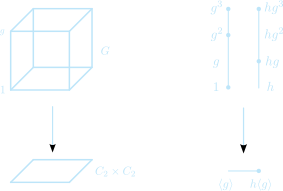
If you did everything right, you should get the following classification: The group of order 8 with all non-trivial elements having order 2 is the product . The groups of order 8 with a cyclic subgroup of order 4 are , , the quaternion group , and the dihedral group .
Semi-direct products
We managed to classify the groups of order 8, but unfortunately this approach is not very practical for larger groups. One problem is that if we fix , then from the picture we only know the coset where is mapped to after being multiplied with , but we have no further information on which element of the coset it gets mapped to. If we abuse geometric terminology a bit, we could say that we are able to find the "coordinate" of the product in the "horizontal direction" only by knowing the group structure on the quotient . Namely, it is the product of the "coordinates" of and . To specify the product completely, we need to know its "coordinate" in the "vertical direction" as well.
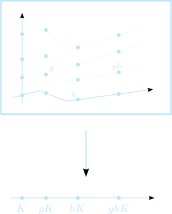
In order to put a "coordinate system" on , where the "vertical coordinate axis" is the kernel , we need to also specify what the "horizontal coordinate axis" is. For each point , we need to specify an element of that represents the point on the vertical coordinate axis with coordinate . This can be encoded as a homomorphism satisfying . Such a homomorphism is called a section of . Given such a section, we can now represent the elements of by coordinate pairs , where and . Let's say such a pair corresponds to the element . Then, an element has coordinates . This defines a bijection (not an isomorphism) between and the Cartesian product (can you see why?).
The next question we can ask is: How does the product of two elements in look like in terms of coordinates? Fix two elements of with coordinates and . Their product is the element . To compute the coordinates of the product , note first that Thus, the first coordinate of is and the second is Hence, we have managed to write the group structure of completely in coordinates. Note that here we do not need to know the group structure on a priori. If we have a section , then we need to only understand the group structures of and in order to understand the group structure on .
As a final remark, I note that the group structure on obtained by writing the products of in coordinates is isomorphic to the semi-direct product , where is the action defined by Thus, we have stumbled upon a construction equivalent to the semi-direct product just by following geometric intuition.
Extension problems
We will finish with extension problems, which nicely tie together the things we have discussed. Let's begin by fixing a SES We learnt that if we only know , we can recover , and if we only know , we can recover . We could then ask, what we can say about if we only know and . This is known as an extension problem. For any given SES as above, the middle term is said to be an extension of by (recall that is "the same" as the projection , which visually speaking "contracts" the cosets of in , so conversely "extends" by ). Solving the extension problem means classifying all possible extensions of by .
Finite groups
We actually solved an extension problem without realising it when we classified the groups of order 8. We split the problem into cases based on what orders the elements have. If a group of order 8 has an element of order 4, then the subgroup generated by is a normal subgroup of order 4. The quotient has order , so it must be the cyclic group . Thus, the groups of order 8 containing an element of order 4 are precisely the extensions of by We classified the extensions successfully, and they are: , , , and .
One could hope that solving extension problems would give a general approach to classifying all finite groups that is inductive on the order. If we have classified all groups of order , then we can list all the pairs of non-trivial groups with orders adding to . If for each such pair we classify the extensions of by , do we then get all the groups of order ? The only way that a group wouldn't arise as an extension of two groups of smaller order is if it has no proper, non-trivial normal subgroups. Such groups are said to be simple.
So, in order to approach the (undoubtedly megalomaniac) project of classifying all finite groups, we need to first classify finite simple groups, and then give a solution to the extension problem. The classification of finite simple groups, which was completed mostly towards the end of the 1900-century, is one of the most famous and grand achievements in the history of mathematics. However, the extension problem does not have a complete solution for finite groups.
Split extensions
Although the general extension problem is not solved, there is a solution to classifying the so-called split extensions. An extension is said to be a split extension, if admits a section. In other words, if there is a group homomorphism such that . I hope this sounds familiar. Indeed, such extensions are classified by the semi-direct products.
Sometimes it is possible to prove that given a pair of groups, all the extensions of by are split. For example, any group of order 12 is a split extensions of a pair , where one of the groups has order 3 and the other has order 4. Using this fact, Keith Conrad gives a nice account of the classification of groups of order 12 in one of his blurbs. This is generalised by the Schur-Zassenhaus theorem, which states that all extensions of finite groups with coprime orders are split.
On the other hand, not all extensions are split. While the extensions are split, the extensions are not (can you find sections in the first two cases and show that there are no sections in last two?).
Abelian extensions
Another case where there is a novel way to solve the extension problem is where the first group in the extension is known to be Abelian. The extension problem is solved in this case by group cohomology. Because is Abelian and the last group acts on by for and , one can construct the second cohomology group . It turns out that this group is always in bijection with the set of extensions of by that induce the same action of on (up to isomorphism).
Since cyclic groups are Abelian, group cohomology can be used to find all extensions of by even though not all of them are split. Thus, we will be able to verify that the four groups we got earlier by the process of elimination are the only extensions of by . We only need to compute the cohomology groups for the different actions of on . Let's first figure out what the possible actions are. It's easy to check that there are two possible actions. There's the trivial action that maps everything to the identity morphism on , denote it by . In addition, there is the action that sends the generator of to the automorphism that swaps and , where is a generator of , denote this action by .
Group cohomology is an example of a derived functor, which are seen in homological algebra, and it is defined in the same way as derived functors usually are. The first thing that needs to be done is to compute a suitable resolution. In this case we want to resolve the module over the group ring where is a generator of . The integers are resolved by the long exact sequence Here maps an element to the sum . The maps and multiply an element of by and respectively.
Once we have fixed an action of on , we can view as a module over . Then, we remove from the above sequence and take -module homs to to obtain a cochain complex Finally, the group cohomology is the cohomology of this cochain complex.
Note that , so we actually have a cochain complex Then, the second cohomology group is . If one now tracks the morphisms, one will see that is defined by multiplying an element of by and is defined by multiplying by . Now, for the sake of clarity let's denote by the cohomology where we equip with the trivial action and similarly for .
If we equip with the action , then and . Thus, . If is equipped with the action , then and . Hence, we also have . In conclusion, we have in total four extensions of by . The extensions induce the trivial action on and the extensions induce the action on .